Tag Archives: home front

Events

Introducing “Blitz and Peaces”

We are very pleased to introduce “Blitz and Peaces” who will be on the streets of Liverpool City Centre entertaining and educating visitors to our great city, leaving them feeling they have had a real opportunity to enjoy the sights and sounds of the home front!

The Blitz and Peaces team are incredibly enthusiastic about what they do and have been busy researching the historic details of Liverpool’s experience during the May Blitz in 1941 in preparation for our anniversary event.  Dressed in various full WWII uniforms, they will no doubt capture the imagination of the young and trigger the memories of the old with their songs and stories about life in Britain on the Home Front.

BLITZ AND PEACES
Photography courtesy of J S Dyer ©

When asked why they do what they do they said, “We all love the sense of triumphant human spirit over almost insurmountable odds to ‘keep the home fires burning’ and we all marvel at the ‘save the string’ and ‘make do and mend’ re-cycling drives that were in operation during the war years.  This of course has subsequently come back into sharp focus as people realise the global importance of controlling our own waste and re-cycling used materials.

We love the ‘live for the moment, as who knows what tomorrow will bring’ ethic of people who volunteered to go in to combat in the armed services, and those thrust into danger on the home front from the bombing raids.  Men and women putting life and limb at risk by joining fire services, rescue parties and medical teams, in order to pull together as a community and help their friends and neighbours during this time of peril.

History

The Dockers’ Umbrella in the Blitz

When it was opened in 1893 the Liverpool Overhead Railway was the world’s first electrically-operated overhead railway.  The railway ran close to the River Mersey following the line of Liverpool Docks from Dingle to Bootle.  It gained the affectionate nickname of the Dockers’ Umbrella, as a great proportion of the railway was elevated and dockers could shelter beneath it as they traveled about the docks.

liverpool overhead railway poster

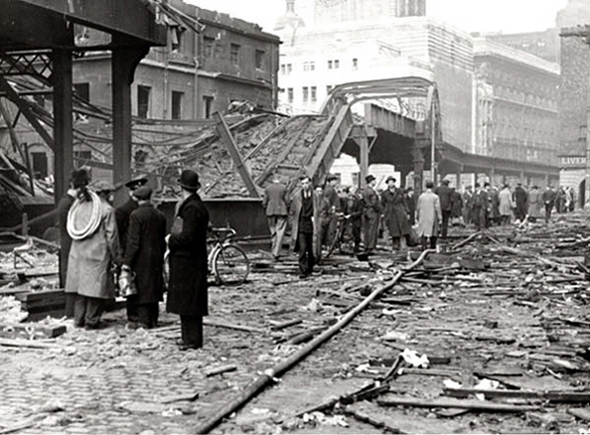
During World War II the Port of Liverpool was the country’s main link across the Atlantic and therefore vital for the constant supply of war materials and food.  Consequently, the long sprawl of docks alongside the Mersey was a major target for the Luftwaffe.  Given its proximity to the docks, it wasn’t surprising the famous Overhead Railway suffered serious bomb damage during the Blitz.

James Street station was destroyed during the May Blitz of 1941 and was consequently rebuilt on modern lines in 1942.  Damage to public transport made traveling to rest centres and other emergency facilities very difficult for those caught out in the bombing.

overhead railway blitz damage james street
Junction of James Street and Strand Street May 1941

overhead railway blitz

Whenever the railway was disrupted by bomb damage, a shuttle service using buses was called into action.  These vehicles carried passengers to and from working sections of track where they could resume their train journeys.

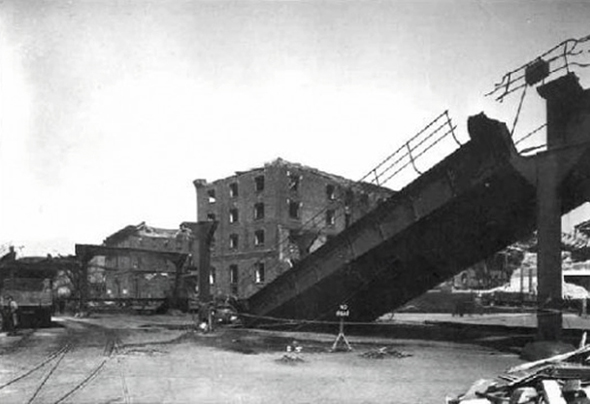
Remarkably, no trains were lost to the bombers during the war, despite regular damage to the track and buildings along the entire length of the line.  Some raids took place at times of the day when the trains were still running, but even after the last night service had ended, the coaches were still vulnerable standing in their depots.

overhead railway blitz sandon dock
Damage to the Overhead at Sandon Dock
overhead railway blitz wapping
Bomb raids cause a warehouse at Wapping Dock to collapse onto the line

Even though there was a desperate need for steel and other raw resources for the war effort, the Dockers’ Umbrella was considered so important to the workings of the port that every effort was made to provide enough metals to repair the railway after the air raids.  However, it was not until November 1941 that all the repairs had been completed and the Overhead was fully open once more.

The war placed a huge strain on the “Ovee” with a massive rise in passengers as a result of the sheer volume of trade coming through Liverpool’s docks.  By 1945 it was carrying 14 million passengers, almost double the figure for 1939.

History

The Story of the Rotunda Theatre

Because of it’s pivotal position at the junction of Scotland road and Stanley road, the Rotunda was an important local landmark since it’s construction in 1860.  Sadly the building was completely destroyed during the Blitz.  But such was it’s presence that even after the war, those who remembered it would still refer to ‘the Rotunda‘ when giving directions to passers-by in Bootle!

rotunda theatre bootle

The site at the junction of Scotland road and Stanley road was built in 1860 and was originally a public house.  In 1866 the proprietor introduced plans for the re-siting of the entertainment on a more extensive upper floor where a larger stage was constructed at the Scotland Road end of the building.  The largely musical fare was then supplemented by sketches.

After further reconstruction with the addition of a gallery, the establishment was opened as the Rotunda Theatre on 23rd November 1869 with a Grand Concert!  Two days later on 25th November, a performance by specially engaged first class artists commenced at precisely 7.00pm.  On that evening it was reported the exterior of the building was brilliantly illuminated by fireworks, and there was also a grand magnesium balloon ascent prior to the opening.

The Rotunda was destroyed by fire in 1877, but was happily rebuilt in a grander style with principal elevations to Stanley Road and Scotland Road connected by a curved corner, surmounted by a dome at the end nearest Scotland Road.  The grand reopening of the new Rotunda Theatre took place on Friday 20th December 1878 and over the next sixty years the various directors of this theatre continued to advance the reputation of the Rotunda as one of the leading centres of melodrama in the provinces.

program rotunda theatre bootle

The Rotunda was destroyed by german bombing on 21st September 1940, but the shell remained standing until 4th May 1941, when fire, bomb blasts and shock waves during the May Blitz caused the walls to finally collapse.  This was quite common, frequent stories were reported of people being injured by falling debris whilst returning to their homes following the ‘all clear’.

4 May 1941 Rotunda Theatre Bootle