Tag Archives: air raid

Personal Accounts

The Story of Joan Jackson

Joan Jackson lived on Raffles Road, Birkenhead with her parents and younger sister when war was declared in 1939.  She has very kindly shared her memories of the Blitz with us…

Joan Jackson and Deryck Fairhurst
Joan Jackson and D-Day veteran, Deryck Fairhurst, at Normandy with D-Day Revisited June 2009

We had numerous bombing raids over Merseyside, but the first one I remember was in 1940 around Christmas.  I would have been 16 years old at the time.  One day, after tea my mother had decided to ice and decorate some christmas cakes (she was a confectioner), when suddenly the air raid siren started to wail.  We all made our way to the air raid shelter in the back garden.  My parents had made it quite comfortable with a mattress on bricks, cups and saucers, biscuits, candles, torches and games… it had to be relatively comfortable as you never knew how long you’d have to spend in there!

As the war progressed we used the shelter more often and when the raids became more frequent we spent most nights in there.  In early 1942 a huge raid was in progress and our road received a direct hit which destroyed several houses and seriously damaged many others, including ours.  I remember my little sister was very distressed.  It sounds silly now, but I distinctly recall saying to her, “Don’t cry Barbara, it’s only a bomb!”

The damage to our house proved beyond repair and the family was forced to split up.  My parents went to Holt and I moved to Upton where I started my training to become a nurse.

History

Liverpool One 70 years ago

This aerial photograph was taken by RAF reconnaissance on 11th June 1941.  It shows clearly the severity of the bomb damage in Liverpool City Centre.  The Albert dock and Three Graces can be seen to the left of the image and the sheer devastation of the area around Paradise Street is all too obvious.

liverpool docks blitz damage 1941
© (NMR RAF/13H/UK789 110) English Heritage (NMR) RAF photography
paradise street blitz
Blitz damage on Paradise Street 1941
lord street blitz
Blitz damage on Lord Street 1941

For over 60 years after the May Blitz, the authorities struggled to find a valuable use for this once prosperous area of central Liverpool, with much of it left abandoned as wasteland.  It wasn’t until very recently when it was redeveloped as the Liverpool One Shopping District, that this area found a useful identity once again.

History

The Terror of the Heinkel Bombers

The Heinkel He 111 was a German aircraft designed by Siegfried and Walter Günter in the early 1930s in direct violation of the Treaty of Versailles.  Often described as a “wolf in sheep’s clothing“, it masqueraded as a transport aircraft, but its purpose was to provide the Luftwaffe with a fast medium bomber.

heinkel bomber

Perhaps the best-recognised german bomber due to its distinctive “greenhouse” nose, the Heinkel was the most numerous and the primary Luftwaffe bomber during the early stages of World War II, until the dog fights of the Battle of Britain exposed its weaknesses; its poor maneuverability, weak defensive armament and relatively low speed.  Sadly, there were too few fighter planes available to defend Liverpool in the air and so the Heinkel bombers were free to undertake the intense attack on the city in May 1941 with little risk of interference from the RAF…

681 Luftwaffe Heinkel and Dornier bombers took part in the May Blitz on Liverpool; 2,315 high explosive bombs and 119 other explosives such as incendiaries were dropped indiscriminately on factories, ships, offices, warehouses, schools, businesses and homes.

History

The Tragedy of Durning Road

The direct hit on a shelter in Durning Road, Edge Hill, was the worst single incident in the Liverpool Blitz as regards to loss of life.  This occurred in the early hours of 29th November 1940, during the heaviest air raid to date.

Approximately 300 people were tightly packed into the shelter in the basement of the Ernest Brown Junior Instructional Centre in Durning Road, Edge Hill.  It was the boiler room, chosen because it had a reinforced ceiling with metal girders running across it.  It would have been a safe enough place if bombs fell nearby, but it could not withstand a direct hit.

When a parachute mine hit the three-storey building, it collapsed into the shelter below, crushing many of its occupants.   Boiling water from the central heating system and gas from fractured mains poured in.  Raging fires overhead also made rescue work extremely dangerous.  In all, 166 men, women and children were killed and many more were seriously injured.

Durning Road Blitz tragedy Liverpool

Durning Road Blitz tragedy Liverpool

ARP wardens, firemen and volunteers worked tirelessly to recover survivors.  It took two days to pull the bodies out from the shelter and in the end, with fear of disease rampant, the body parts which had not been recovered were covered with lime and the basement was sealed.  The horror devastated the tight-knit community around Edge Hill.  One lady, a Mrs. Lucas, lost four children in the tragedy and did not speak for six months afterwards.

Winston Churchill later called it “the worst single (civilian) incident of the war“.

History

The Sound of the Air Raid Siren

Air raid sirens first sounded the warning in London in September 1939 shortly after the outbreak of war with Germany.  During the May Blitz of 1941, the frightening sound of the air raid siren could be heard across Liverpool several times each day.

world war II air raid poster

The “Carter” air raid siren, manufactured by Gents of Leicestershire was used exclusively in Britain throughout World War II.  The sirens made a very loud and long signal or warning sound. For an alert, the siren sound pitch rose and fell alternately, whereas the “All Clear” was a continuous sound from the siren.

When people heard the siren they would stop what they were doing and make for shelter.  Shelters varied from underground stations, to smaller prefabricated Anderson and Morrison shelters.  If the bombing seemed light, many people preferred to stay in their homes under the stairs.  Government warning messages describing how best to react if the siren sounds, were broadcasted to the general public over the wireless and at the pictures.

Volunteer air raid precaution (ARP) wardens would protect civilians from the danger of air-raids as much as possible during a bomb attack; directing people to the nearest shelter and using their knowledge of the local area to help find and reunite family members who had been separated in the mad rush to escape the bombing.

History

The Dockers’ Umbrella in the Blitz

When it was opened in 1893 the Liverpool Overhead Railway was the world’s first electrically-operated overhead railway.  The railway ran close to the River Mersey following the line of Liverpool Docks from Dingle to Bootle.  It gained the affectionate nickname of the Dockers’ Umbrella, as a great proportion of the railway was elevated and dockers could shelter beneath it as they traveled about the docks.

liverpool overhead railway poster

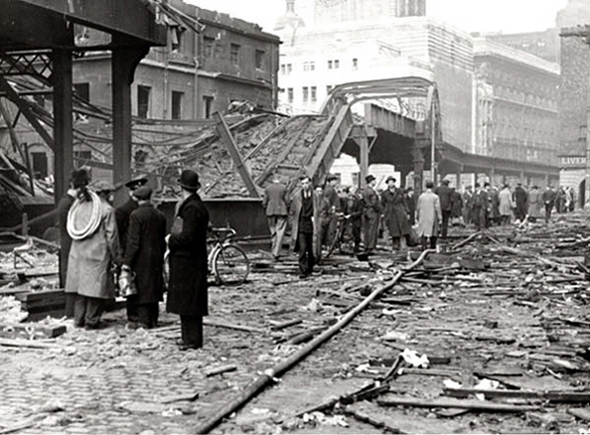
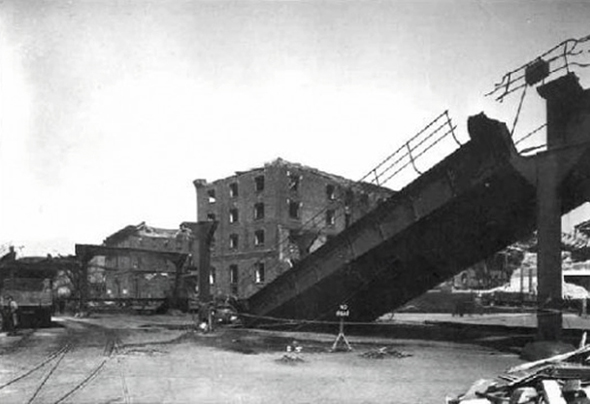
During World War II the Port of Liverpool was the country’s main link across the Atlantic and therefore vital for the constant supply of war materials and food.  Consequently, the long sprawl of docks alongside the Mersey was a major target for the Luftwaffe.  Given its proximity to the docks, it wasn’t surprising the famous Overhead Railway suffered serious bomb damage during the Blitz.

James Street station was destroyed during the May Blitz of 1941 and was consequently rebuilt on modern lines in 1942.  Damage to public transport made traveling to rest centres and other emergency facilities very difficult for those caught out in the bombing.

overhead railway blitz damage james street
Junction of James Street and Strand Street May 1941

overhead railway blitz

Whenever the railway was disrupted by bomb damage, a shuttle service using buses was called into action.  These vehicles carried passengers to and from working sections of track where they could resume their train journeys.

Remarkably, no trains were lost to the bombers during the war, despite regular damage to the track and buildings along the entire length of the line.  Some raids took place at times of the day when the trains were still running, but even after the last night service had ended, the coaches were still vulnerable standing in their depots.

overhead railway blitz sandon dock
Damage to the Overhead at Sandon Dock
overhead railway blitz wapping
Bomb raids cause a warehouse at Wapping Dock to collapse onto the line

Even though there was a desperate need for steel and other raw resources for the war effort, the Dockers’ Umbrella was considered so important to the workings of the port that every effort was made to provide enough metals to repair the railway after the air raids.  However, it was not until November 1941 that all the repairs had been completed and the Overhead was fully open once more.

The war placed a huge strain on the “Ovee” with a massive rise in passengers as a result of the sheer volume of trade coming through Liverpool’s docks.  By 1945 it was carrying 14 million passengers, almost double the figure for 1939.

History

The Story of the Rotunda Theatre

Because of it’s pivotal position at the junction of Scotland road and Stanley road, the Rotunda was an important local landmark since it’s construction in 1860.  Sadly the building was completely destroyed during the Blitz.  But such was it’s presence that even after the war, those who remembered it would still refer to ‘the Rotunda‘ when giving directions to passers-by in Bootle!

rotunda theatre bootle

The site at the junction of Scotland road and Stanley road was built in 1860 and was originally a public house.  In 1866 the proprietor introduced plans for the re-siting of the entertainment on a more extensive upper floor where a larger stage was constructed at the Scotland Road end of the building.  The largely musical fare was then supplemented by sketches.

After further reconstruction with the addition of a gallery, the establishment was opened as the Rotunda Theatre on 23rd November 1869 with a Grand Concert!  Two days later on 25th November, a performance by specially engaged first class artists commenced at precisely 7.00pm.  On that evening it was reported the exterior of the building was brilliantly illuminated by fireworks, and there was also a grand magnesium balloon ascent prior to the opening.

The Rotunda was destroyed by fire in 1877, but was happily rebuilt in a grander style with principal elevations to Stanley Road and Scotland Road connected by a curved corner, surmounted by a dome at the end nearest Scotland Road.  The grand reopening of the new Rotunda Theatre took place on Friday 20th December 1878 and over the next sixty years the various directors of this theatre continued to advance the reputation of the Rotunda as one of the leading centres of melodrama in the provinces.

program rotunda theatre bootle

The Rotunda was destroyed by german bombing on 21st September 1940, but the shell remained standing until 4th May 1941, when fire, bomb blasts and shock waves during the May Blitz caused the walls to finally collapse.  This was quite common, frequent stories were reported of people being injured by falling debris whilst returning to their homes following the ‘all clear’.

4 May 1941 Rotunda Theatre Bootle